.png)

Traditional marketing efforts often fail to generate sustainable growth when they rely solely on transactional tactics. According to the 2024 Consumer Behavior Report by Society22, 97% of clients who adopt a strategic public relations approach see featured placements in top-tier media, leading to increased traffic and revenue. This statistic highlights a critical shift in how modern brands build authority. While paid advertising offers immediate visibility, strategic PR outreach builds the foundational trust that converts high-intent buyers. Understanding the mechanics behind both strategies is essential for any business aiming to scale beyond its current limitations. (The Role of) (Top PR Plans amp)
The Core Difference: Trust vs. Impression
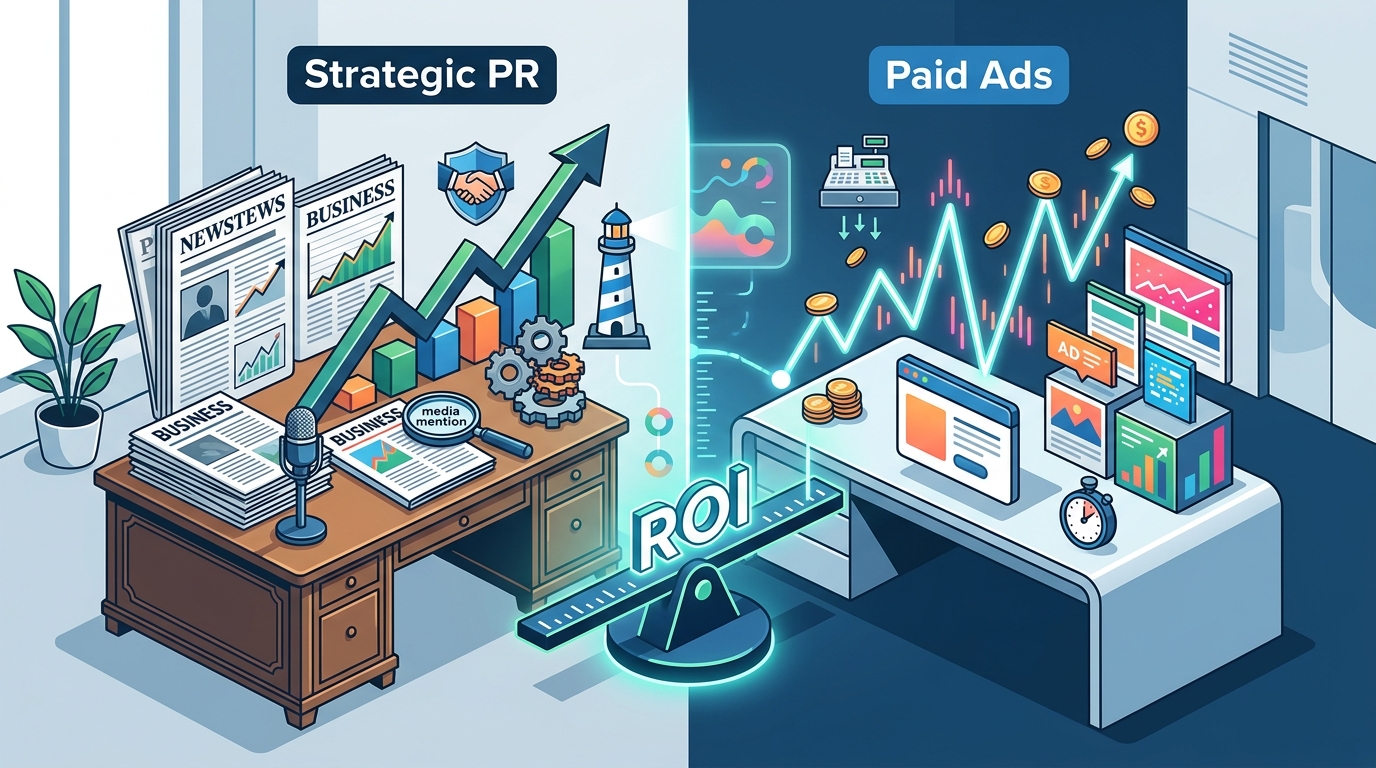
Paid advertising operates on a model of interruption. You pay a platform to display your message to a specific audience. The goal is visibility. Strategic public relations operates on a model of validation. You earn the right to be heard by journalists, editors, and industry leaders. The goal is authority.
When a brand appears in a respected publication, it borrows that publication's credibility. This is known as the halo effect. Consumers are increasingly skeptical of direct advertising claims. They trust third-party endorsements more. A feature in a major outlet serves as a social proof mechanism that paid ads cannot replicate. This distinction is vital for companies in competitive sectors like FinTech or Cyber Security, where trust is the primary currency.
Paid ads stop working the moment you stop paying. PR placements continue to generate organic traffic and backlinks long after the initial pitch. This creates a compounding effect on brand awareness that is difficult to achieve through ad spend alone.
Longevity of Impact and Content Lifespan
The lifespan of a marketing asset determines its long-term value. A social media ad or a search engine marketing campaign has a short shelf life. Once the budget is exhausted, the visibility vanishes. In contrast, a well-placed PR article can remain indexed in search engines for years. It continues to attract visitors and generate leads without additional cost. (The Role of)
According to data from Forbes, content that is endorsed by authoritative sources ranks higher in search results. This organic longevity provides a stable foundation for brand growth. It allows companies to build a digital footprint that grows stronger over time. Paid advertising, while effective for quick wins, does not contribute to this long-term equity in the same way.
Furthermore, PR content is often repurposed. A single interview can be turned into blog posts, social media snippets, and email newsletter content. This multiplies the return on the initial effort. Paid ads require constant creation and optimization to maintain performance. The resource drain is significant. PR offers a more sustainable path to consistent brand presence.
Cost Efficiency and ROI Analysis
Comparing the cost efficiency of PR and paid ads requires looking at the total cost of ownership. Paid advertising has a clear, upfront cost. You know exactly what you pay per click or per impression. However, the cost per acquisition often rises as competition increases. Bidding wars can erode margins quickly.
Strategic PR involves a different investment structure. You are paying for expertise, relationships, and strategy. While the initial cost may seem higher, the return on investment is often superior. A single feature in a top-tier publication can generate millions of impressions. The cost per impression is fraction of that of paid channels. This is particularly true for B2B SaaS companies targeting niche decision-makers.
| Feature | Strategic PR Outreach | Paid Advertising |
|---|---|---|
| Primary Goal | Authority and Trust | Visibility and Conversion |
| Lifespan | Long-term (Years) | Short-term (Days/Weeks) |
| Credibility | High (Third-party validation) | Low (Self-promoted) |
| Cost Model | Fixed Fee / Retainer | Pay-per-click / CPM |
| SEO Impact | Significant Backlink Value | Minimal Direct Impact |
The table above illustrates the fundamental differences in how these strategies function. PR is an investment in brand equity. Paid ads are an operational expense for customer acquisition. Both have their place, but they serve different stages of the customer journey. For early-stage companies, PR can help establish the market position needed for paid ads to work effectively.
The Credibility Boost of Earned Media
Earned media refers to publicity gained through promotional efforts other than paid advertising. This includes news coverage, reviews, and social media mentions. The credibility boost from earned media is substantial. Consumers view these mentions as unbiased opinions. This perception drives higher engagement rates.
A study by Fast Company indicates that brands with strong PR profiles experience higher customer loyalty. This is because trust reduces the friction in the buying process. When a potential client sees your brand mentioned alongside industry leaders, their hesitation decreases. Paid ads cannot replicate this psychological shift. They can attract attention, but they cannot build the same level of emotional connection.
Additionally, earned media often reaches audiences that are difficult to target with paid ads. Journalists and editors have their own readerships. These readers may not be on the specific ad networks you are using. PR allows you to tap into these existing communities. It expands your reach beyond your paid targeting parameters. This organic expansion is crucial for breaking into new markets or demographics.
Integrating PR with Paid Channels
The most effective brand awareness strategies do not choose between PR and paid ads. They integrate them. This approach is known as the "spray and pray" method when done poorly, but "amplified earned media" when done correctly. You use PR to generate the story and the credibility. You use paid ads to amplify that story to a wider audience.
For example, when a client gets featured in a major publication, you can run a paid campaign targeting readers of that publication. The ad copy can reference the feature. This creates a powerful synergy. The paid traffic is more likely to convert because it is backed by the credibility of the PR placement. This strategy maximizes the ROI of both channels.
Society22 specializes in this integrated approach. We help clients secure top-tier media placements and then guide them on how to leverage those wins. Our case studies demonstrate how this combination drives measurable growth. By combining the reach of paid media with the authority of earned media, brands can achieve dominance in their respective industries.
Key Takeaways
- Trust Factor: Strategic PR builds trust through third-party validation, whereas paid ads rely on direct promotion.
- Longevity: PR content has a long-term lifespan, providing ongoing SEO and brand benefits, unlike the transient nature of paid ads.
- ROI: While paid ads offer immediate results, PR often provides a higher long-term return on investment through compounding brand equity.
- Credibility: Earned media boosts brand credibility significantly, leading to higher customer loyalty and conversion rates.
- Integration: Combining PR with paid amplification creates a powerful synergy that maximizes reach and effectiveness.
- Industry Fit: PR is particularly effective for complex industries like Wealth Management where trust is paramount.
- Agency Role: Working with a specialized agency like Society22 ensures access to top-tier media outlets and strategic guidance.
Frequently Asked Questions
Is PR more expensive than paid advertising?
PR can have a higher upfront cost than small-scale ad campaigns. However, when measured against the long-term value of earned media and brand equity, it is often more cost-effective. Paid advertising requires continuous spending to maintain visibility.
Can PR replace paid advertising entirely?
While PR can drive significant organic traffic, it is rarely a complete replacement for paid ads. The most effective strategies use both. PR builds the foundation of trust, while paid ads accelerate reach and conversion.
How long does it take to see results from PR?
Strategic PR can yield results within 30 days. However, the full impact of brand authority builds over time. Unlike paid ads, which stop working immediately after the budget ends, PR benefits compound over months and years.
What industries benefit most from strategic PR?
Industries that require high levels of trust, such as Healthtech, Venture Capital, and IPO services, benefit immensely from PR. It helps establish credibility in competitive markets.
How does PR impact SEO?
PR generates high-quality backlinks from authoritative domains. These backlinks are a critical ranking factor for search engines. They signal to Google that your brand is a trusted source of information, improving your organic search visibility.
What is the difference between earned and owned media?
Owned media includes your website and blog. Earned media includes PR placements and mentions. Paid media includes ads. PR focuses on earning the right to be heard through valuable storytelling and relationships.
How can I measure the success of my PR efforts?
Success can be measured by media impressions, backlink quality, referral traffic, and sentiment analysis. Society22 provides detailed reporting on these metrics to demonstrate the tangible impact of our campaigns.
Ready to Elevate Your Brand?
Stop relying solely on interruption-based marketing. Build a brand that commands respect and drives organic growth. Contact Society22 today to discuss how our strategic PR outreach can transform your brand awareness strategy. We are ranked #5 Best Company in America for a reason. Let us help you achieve similar results.