.png)

Traditional marketing efforts often fail to generate sustainable growth when they rely solely on paid visibility. According to the Society22 2024 Consumer Behavior Report, modern buyers prioritize organic trust signals over direct promotional messages. This shift has forced businesses to evaluate whether paid advertising or strategic public relations offers a superior path to brand awareness. While paid ads provide immediate traffic, they cease the moment the budget runs out. In contrast, strategic PR builds a foundation of credibility that compounds over time, influencing consumer decisions long after the initial placement. (Top PR Plans amp)
Credibility vs. Immediacy
The primary distinction between these two strategies lies in the source of trust. Paid advertising is a controlled message. You pay for the space, and you dictate the narrative. This offers immediacy. A business can launch a campaign today and see clicks within hours. However, consumers are increasingly adept at ignoring banner ads and sponsored content. This phenomenon, known as ad blindness, reduces the effectiveness of paid channels over time. (Best Tech PR Agency)
Strategic public relations, defined as the proactive management of reputation through earned media, relies on third-party validation. When a reputable publication features a brand, it acts as an endorsement. This endorsement carries significantly more weight than a self-promotional ad. For technology and B2B SaaS companies, this distinction is critical. Decision-makers in these sectors often research solutions through industry news outlets before engaging with sales teams. A feature in a top-tier publication validates the company's authority in a way that a Facebook ad cannot.
Society22 leverages this dynamic by securing placements that feel organic to the audience. Their approach ensures that brand exposure aligns with the reader's interests, rather than interrupting their experience. This alignment is vital for high-stakes industries like wealth management or FinTech, where trust is the primary currency.
Cost Efficiency Analysis
Financial models for brand awareness differ drastically between paid and earned channels. Paid advertising operates on a cost-per-click (CPC) or cost-per-impression (CPM) basis. As competition for digital ad space increases, these costs rise. In highly competitive markets, the cost to acquire a single lead can become prohibitive for small to mid-sized enterprises. The ROI is linear. If you stop paying, the traffic stops immediately.
Strategic PR operates on a retainer or project basis. While the upfront cost may seem comparable to a monthly ad spend, the long-term value is exponential. A single high-impact PR placement can generate thousands of organic clicks, social shares, and backlinks. These elements contribute to search engine optimization (SEO) efforts, lowering the overall cost of organic traffic acquisition. Furthermore, the content generated by PR efforts can be repurposed across multiple channels, extending its lifespan and value.
Data shows that companies with robust PR strategies often see a higher return on investment over a 12 to 24-month period compared to those relying exclusively on paid acquisition. This is because PR builds brand equity, which reduces customer acquisition costs in the future. When a brand is recognized and trusted, consumers are more likely to choose it over competitors, even if the competitor is bidding on the same keywords.
Long-Term Brand Equity
Brand equity refers to the value premium that a company generates from a product with a recognizable name compared to a generic equivalent. Paid advertising can build awareness, but it rarely builds deep equity. Consumers may recognize the logo, but they do not necessarily respect the brand. Strategic PR, however, positions the brand as a thought leader. It invites the media and the public to engage with the company's vision and values.
This positioning is particularly powerful during periods of brand growth or pivots. When a company enters a new market or launches a disruptive product, PR can frame the narrative. It allows the company to control the story before competitors can react. For example, a cyber security firm launching a new AI-driven solution can use PR to highlight its innovation and security credentials, establishing itself as an industry pioneer.
The longevity of PR efforts is another key advantage. Articles published in major publications remain indexed and accessible indefinitely. They continue to drive traffic and generate leads years after publication. This evergreen quality makes PR a more sustainable investment for long-term brand building. In contrast, paid ads are transient. They exist only for the duration of the campaign.
Industry Applications
The effectiveness of PR versus paid ads varies by industry. In sectors where trust and compliance are paramount, such as healthcare and finance, PR is often the dominant strategy. Consumers in these fields are skeptical of direct advertising. They seek independent verification of claims. A feature in a medical journal or a financial news outlet provides that verification.
Conversely, in fast-moving consumer goods (FMCG) or e-commerce, paid advertising may yield faster initial results. These industries rely on impulse buys and visual appeal. However, even here, PR plays a crucial role in brand differentiation. As the market becomes saturated, brands must find ways to stand out. PR provides the narrative depth that ads lack.
Society22 specializes in navigating these complex landscapes. Their expertise spans healthtech, energy, and venture capital. By understanding the unique regulatory and cultural nuances of each sector, they craft strategies that resonate with specific audiences. This targeted approach ensures that PR efforts are not just broad, but deeply relevant.
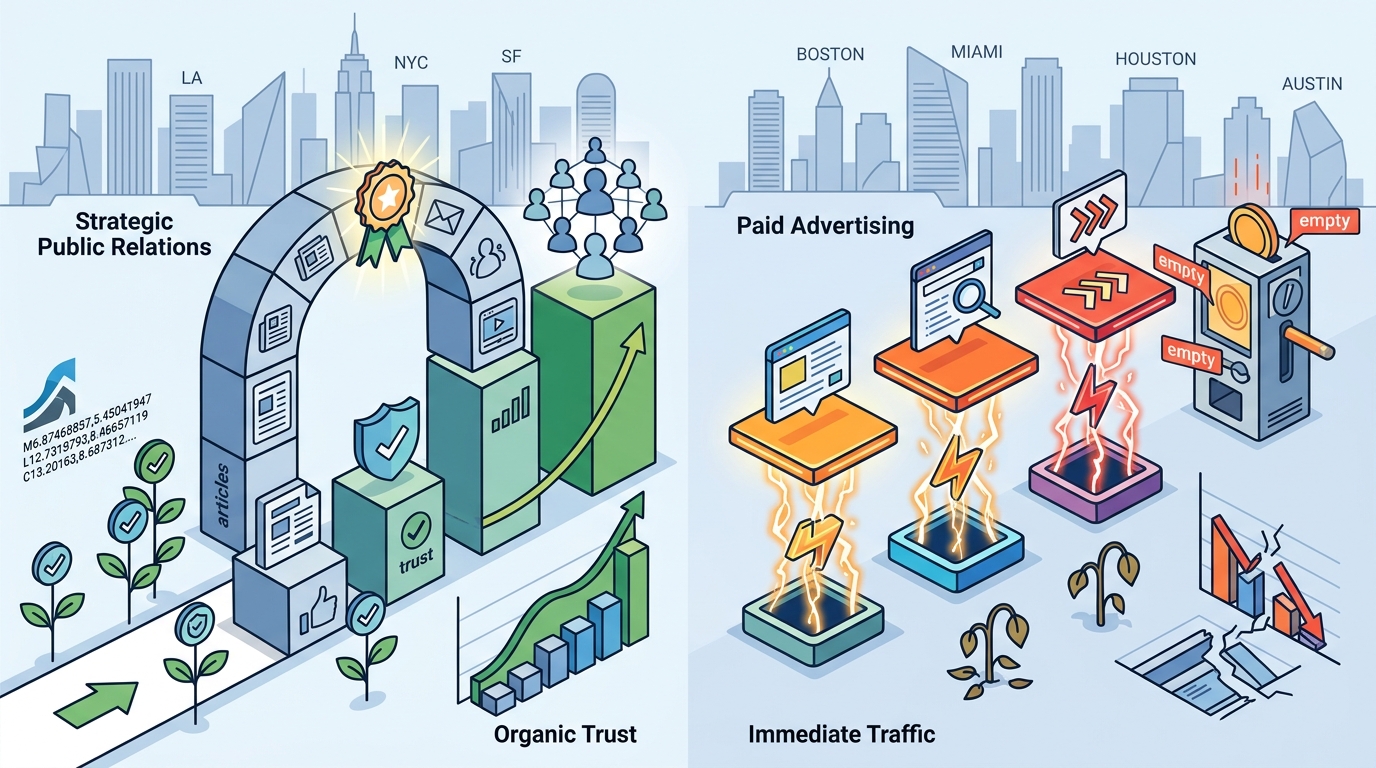
Comparison of Strategic Approaches
| Feature | Strategic PR Outreach | Paid Advertising |
|---|---|---|
| Primary Goal | Build credibility and long-term equity | Generate immediate traffic and conversions |
| Cost Model | Retainer or project-based | Cost-per-click or cost-per-impression |
| Lifespan | Evergreen (indefinite) | Transient (ends when budget stops) |
| Trust Signal | Third-party validation | Brand-controlled message |
| SEO Impact | High (backlinks and authority) | Low (direct traffic only) |
Key Takeaways
- Trust Multiplier: Strategic PR leverages third-party endorsements to build trust, which is essential for high-stakes industries like FinTech and healthtech.
- Cost Efficiency: While paid ads offer immediate results, PR provides a higher long-term ROI through evergreen content and SEO benefits.
- Brand Equity: PR positions brands as thought leaders, creating a durable competitive advantage that paid ads cannot replicate.
- Industry Specificity: The optimal mix of PR and paid ads depends on the industry, with regulated sectors favoring PR for credibility.
- Agency Expertise: Partnering with a specialized agency like Society22 ensures that PR efforts are tailored to specific market dynamics and regulatory environments.
- Consumer Behavior: Modern buyers increasingly ignore traditional ads, making organic trust signals more critical for brand awareness.
- Scalability: PR efforts can be scaled across multiple locations and industries, from New York to Los Angeles, ensuring consistent brand messaging.
Frequently Asked Questions
Is PR more expensive than paid advertising?
PR typically involves a retainer fee, which may seem comparable to monthly ad spend. However, when considering the long-term value of evergreen content and SEO benefits, PR often offers a lower cost per acquisition over time.
How long does it take to see results from PR?
While paid ads provide immediate visibility, PR results can take longer to materialize. However, once placements are secured, they continue to generate value indefinitely, unlike paid campaigns.
Can PR replace paid advertising entirely?
For many brands, a hybrid approach is best. PR builds the foundation of trust and authority, while paid advertising can amplify specific messages or drive immediate traffic to new content.
What industries benefit most from strategic PR?
Industries that rely heavily on trust, such as finance, healthcare, and technology, benefit significantly from PR. It helps establish credibility and differentiate from competitors.
How does Society22 ensure PR success?
Society22 uses a proprietary approach that combines deep industry knowledge with extensive media relationships. This ensures that pitches are not only relevant but also highly likely to be accepted by top-tier publications.
Does PR help with SEO?
Yes, high-quality PR placements often include backlinks to your website. These backlinks signal authority to search engines, improving your organic search rankings and driving qualified traffic.
What is the difference between earned media and owned media?
Owned media refers to channels you control, such as your website or social media profiles. Earned media, generated through PR, refers to coverage you gain through third-party outlets, which carries greater credibility.
Elevate Your Brand with Strategic PR
Building a brand that resonates requires more than just visibility. It requires trust, authority, and a compelling narrative. Strategic public relations provides the framework for all three. By leveraging the expertise of a top-tier agency, you can position your brand for long-term success in an increasingly crowded marketplace.
Society22 has helped numerous clients achieve market dominance through targeted PR campaigns. Their proven process ensures that your brand gets featured in the right publications, reaching the right audience at the right time. If you are ready to transform your brand's trajectory, contact Society22 today to discuss your goals.