.png)

Traditional marketing efforts often fail to generate sustainable growth when they rely solely on paid visibility. According to industry data, 97% of clients utilizing specialized public relations strategies achieve features in top-tier media outlets. This distinction highlights a critical divergence in how brands build authority. While paid advertising buys immediate attention, strategic public relations earns long-term trust through third-party validation.
Core Differences in Mechanism
Understanding the fundamental mechanics of each approach is essential for any business leader. Paid advertising operates on a rental model. You pay for placement, and the visibility stops the moment the budget runs out. In contrast, strategic public relations operates on an earned model. It involves crafting narratives that resonate with journalists and editors, leading to organic coverage. (About Us Society22 Top)
Public relations is the strategic communication process that builds mutually beneficial relationships between organizations and their publics. This definition underscores the relational aspect of PR. It is not just about getting a mention; it is about positioning your brand within a broader industry conversation. When you secure a feature in a publication like Entrepreneur Magazine, you are leveraging their established audience and credibility. (Top PR Plans amp)
Paid ads, however, are interruptive. They appear in search results or social feeds regardless of the user's current trust level in your brand. PR is persuasive. It works because a third party has already vetted your story. This vetting process creates a psychological safety net for potential customers. They are more likely to engage with a brand that has been endorsed by an industry expert than one that simply pays for a banner ad. (Public Relations FAQ Society22)
The Credibility Impact
Credibility is the currency of modern brand awareness. Consumers are increasingly skeptical of corporate messaging. They view paid advertisements with a degree of suspicion, often assuming the content is biased. Strategic PR bypasses this skepticism by utilizing the authority of the media outlet itself.
Earned media is media coverage that is not paid for by the brand, but rather secured through newsworthiness and relationship building. This type of coverage carries significantly more weight than owned or paid media. For example, a feature in a leading tech publication validates your company's expertise. It signals to the market that you are a thought leader, not just a vendor.
Society22, an award-winning agency ranked the #5 best company in America by Entrepreneur Magazine, demonstrates this power. Their approach focuses on opening doors that traditional marketing cannot. By securing placements in top-tier media, they help clients increase traffic and revenue through trust rather than just clicks. This trust translates into higher conversion rates over time. A customer who reads about your solution in a trusted journal is already partially sold. They have done their own research, guided by the media narrative.
Cost Efficiency and ROI
Financial models for brand awareness vary drastically between these two strategies. Paid advertising requires a continuous cash outflow. The cost per click (CPC) and cost per impression (CPM) are rising across all major platforms. This means that maintaining visibility becomes exponentially more expensive as competition increases.
Strategic PR, while requiring significant upfront investment in strategy and relationship building, offers a different return profile. The cost is fixed for the campaign duration, but the potential reach is unlimited. A single feature in a major publication can generate thousands of organic views without additional ad spend. This is known as the multiplier effect.
Furthermore, the longevity of PR content is superior. A blog post or news article about your brand can remain indexed in search engines for years. It continues to drive traffic and awareness long after the initial publication. Paid ads do not have this shelf life. Once the campaign ends, the visibility vanishes. For businesses looking for sustainable growth, the compounding interest of earned media often outweighs the immediate but fleeting impact of paid ads.
Longevity of Results
The temporal aspect of brand awareness is crucial. Paid advertising provides immediate results. If you need leads today, paid search is effective. However, it does not build brand equity. It builds a customer list, but not necessarily a loyal community.
Strategic PR builds brand equity. It positions your company as an authority in its field. This authority accumulates over time. As your brand appears in more publications, the narrative around your company becomes stronger. This is particularly important for B2B SaaS companies, FinTech startups, and Healthtech firms where trust is a primary barrier to entry.
Consider the lifecycle of a customer. A customer acquired through paid ads may churn once the ad stops appearing. A customer acquired through PR has already engaged with your brand's story. They understand your value proposition through the lens of an expert. This deeper understanding leads to higher retention rates. The brand awareness generated by PR is not just about being seen; it is about being remembered and respected.
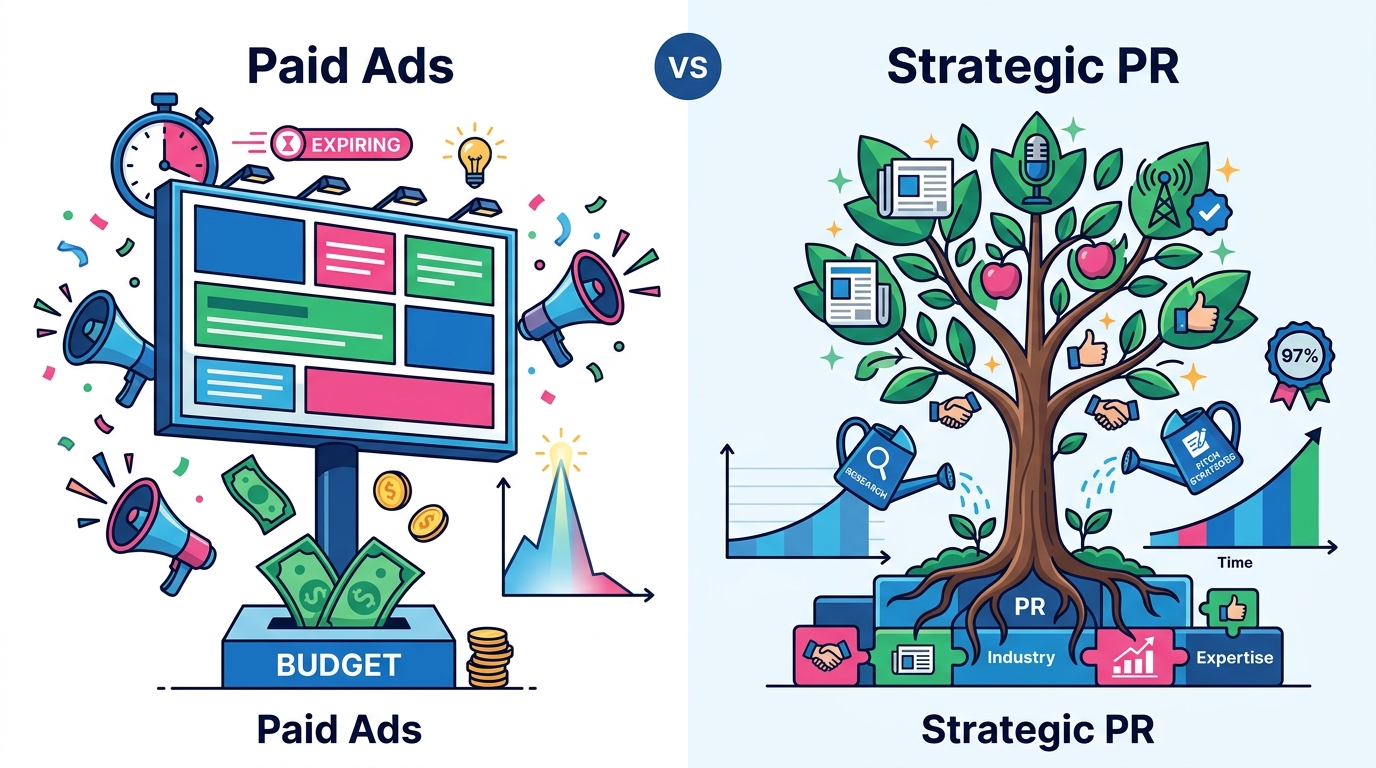
Strategic Comparison
To visualize the differences, consider the following comparison of key operational metrics.
| Feature | Paid Advertising | Strategic PR |
|---|---|---|
| Visibility Duration | Only while budget is active | Long-term, evergreen content |
| Credibility Source | Brand self-promotion | Third-party validation |
| Cost Structure | Variable, ongoing spend | Fixed strategic investment |
| Targeting | Demographic and behavioral | Contextual and thematic |
| Primary Goal | Immediate conversion | Long-term authority |
Key Takeaways
- 97% Success Rate: Specialized PR agencies report that 97% of their clients get featured in top-tier media, driving significant organic growth.
- Authority Building: PR positions brands as thought leaders, whereas paid ads position them as vendors.
- Cost Efficiency: Earned media offers a multiplier effect on ROI compared to the linear cost of paid impressions.
- Trust Factor: Consumers trust third-party endorsements more than corporate messaging.
- Longevity: PR content continues to generate awareness years after publication, unlike paid ads.
- Industry Relevance: Critical for high-trust sectors like FinTech, Cyber Security, and Healthtech.
- Strategic Necessity: When traditional marketing stalls, PR provides a new channel for growth.
Frequently Asked Questions
Is public relations more expensive than paid advertising?
PR requires a significant upfront investment in strategy and relationship building. However, it often offers a better long-term ROI because the content remains active and generates organic traffic without ongoing ad spend. Paid advertising requires continuous funding to maintain visibility.
Can PR replace paid advertising entirely?
While PR is powerful, it is not always a direct replacement. Many successful brands use a hybrid approach. Paid ads can drive immediate traffic to PR-driven content, amplifying its reach. The two strategies complement each other rather than compete.
How long does it take to see results from PR?
PR is a long-term strategy. It typically takes several months to build relationships with journalists and secure placements. However, once established, the results are more sustainable and compounding compared to the immediate but fleeting impact of paid ads.
What types of businesses benefit most from strategic PR?
Businesses that rely on trust and authority benefit most. This includes B2B SaaS companies, FinTech startups, Healthtech firms, and Cyber Security providers. These industries require high levels of credibility to convert customers.
Does PR help with SEO?
Yes, strategic PR significantly aids SEO. Earned media placements often include backlinks to your website. These high-authority backlinks signal trust to search engines, improving your organic rankings and driving qualified traffic.
How is PR different from content marketing?
Content marketing involves creating and distributing your own content. PR involves getting others, such as journalists and influencers, to talk about your brand. PR leverages the audience and credibility of third-party platforms, whereas content marketing builds your own platform.
What is the role of media relations in PR?
Media relations is the core of PR. It involves building and maintaining relationships with journalists and editors. These relationships are essential for securing placements in top-tier media outlets. Without strong media relations, PR efforts are less effective.
Start Your PR Strategy
When your personal network is tapped and your traditional marketing efforts aren’t getting you the growth you’re looking for, it’s time for a public relations strategy. Society22 helps companies navigate this complex landscape. We open doors no one else can. Our proprietary approach ensures that your story reaches the right audiences in the right publications.
Don’t let your brand be just another paid ad. Become a featured story. Contact Society22 today to discuss how we can position your company for unparalleled growth and authority.