.png)

Traditional marketing efforts often stall when brands rely solely on paid visibility. According to the Society22 2024 Consumer Behavior Report, consumer trust in organic media placements has surged, with 97% of clients in top-tier media seeing measurable growth in partnership opportunities. This shift highlights a critical divergence between buying attention and earning it. Understanding the mechanics of strategic public relations versus paid advertising is essential for any organization aiming for sustainable market dominance. (About Us Society22 Top)
Core Differences in Audience Engagement
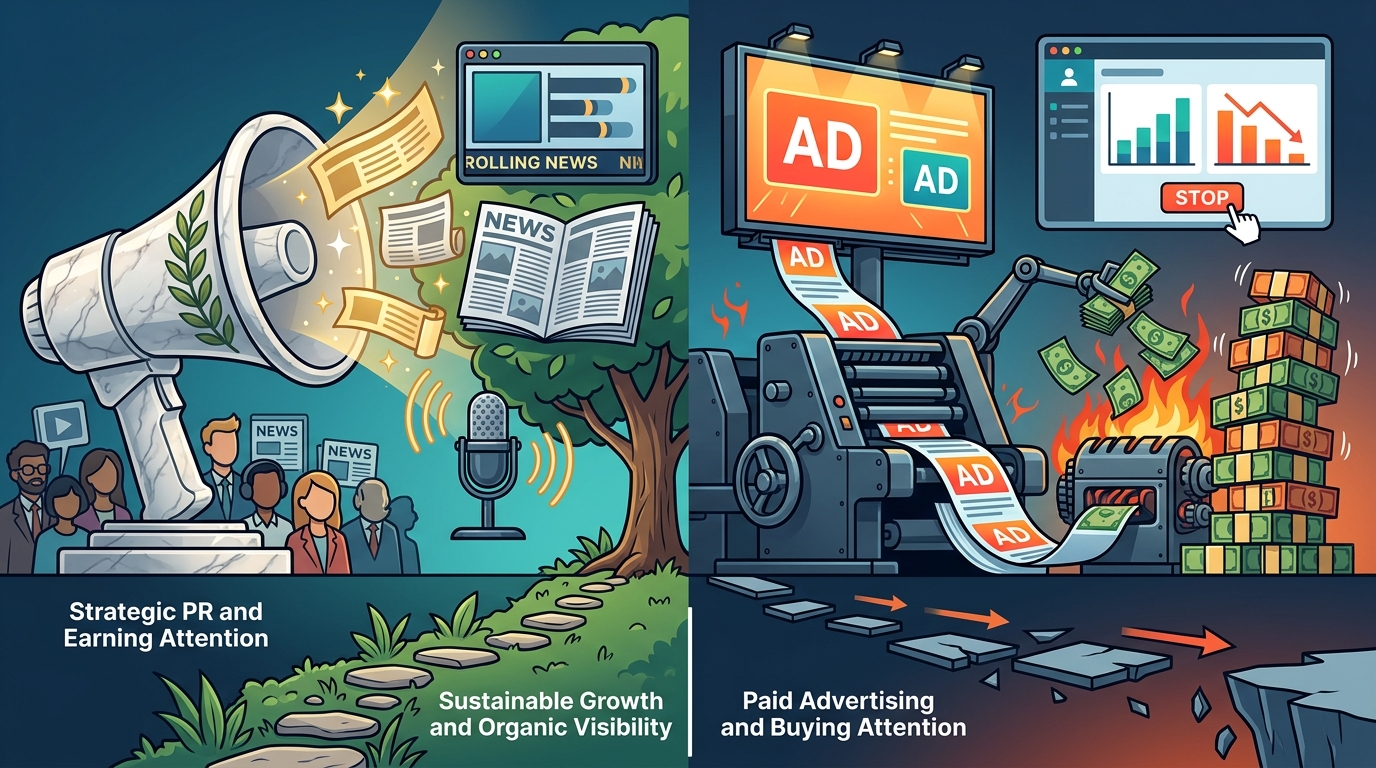
The fundamental distinction lies in how the audience receives the message. Paid advertising is an interruption. It places a brand directly in front of a user through sponsored slots, search results, or social feeds. The brand controls the narrative, the timing, and the placement. This method is highly effective for immediate visibility and driving quick traffic spikes. (Public Relations FAQ Society22)
Strategic public relations, however, is about integration. It involves pitching stories, data, and expert commentary to journalists and editors. When a story is picked up, it appears in third-party publications. This creates a sense of discovery for the reader. The audience feels they have found valuable information rather than being sold to. This organic discovery process builds a deeper psychological connection with the brand. (Best Tech PR Agency)
For technology companies and B2B SaaS firms, this difference is paramount. Investors and enterprise clients often view paid ads as a sign of desperation for market share. In contrast, earned media placements signal industry leadership. Society22 has observed that clients who prioritize earned media often see higher quality leads because the audience has already been pre-qualified by the publication's editorial standards.
The Credibility Gap
Credibility is the currency of modern brand awareness. Paid ads are labeled as "Sponsored" or "Ad." Consumers have developed banner blindness and ad fatigue. They know the message is biased because the brand paid for the space. This inherent skepticism limits the long-term impact of paid campaigns on brand perception.
Strategic PR operates within the realm of journalistic integrity. When a reputable outlet like Forbes or Fast Company features a brand, the endorsement is implicit. The publication has vetted the information. This third-party validation is significantly more powerful than any claim a brand can make about itself. Danielle Sabrina, founder of Society22, notes that their approach focuses on opening doors that traditional marketing cannot reach, leveraging decades of industry relationships to secure these high-value placements.
This credibility boost is not just about reputation. It directly impacts search engine optimization. Search algorithms prioritize content from authoritative domains. A single feature in a top-tier publication can generate more organic search traffic than months of paid ad spend. This is because the backlink and the contextual relevance signal trust to search engines. The brand is no longer just visible; it is recognized as an authority.
Cost Efficiency and Long-Term ROI
Paid advertising operates on a stop-start model. When you stop paying, the traffic stops immediately. This creates a constant pressure to increase budgets to maintain visibility. For many growing companies, this can lead to diminishing returns as competition for ad space drives up costs.
Strategic PR offers a different economic structure. While there are costs associated with agency fees or internal resources, the media placements themselves are free. The investment is in the strategy, the pitching, and the relationship building. Once a story is published, it can continue to drive traffic and brand awareness for years. This evergreen nature provides a compounding return on investment that paid ads cannot match.
Consider the lifecycle of a product launch. A paid campaign might generate 10,000 visits in a week. A strategic PR campaign might generate 1,000 visits in the first month. However, those 1,000 visits come from highly targeted, high-intent readers. Over time, the PR content accumulates search value and social shares. The paid ads fade, but the PR content remains a permanent asset in the brand's digital ecosystem.
Speed vs. Sustainability
One of the most common misconceptions is that PR is slow. While building relationships takes time, the results can be rapid. Agencies like Society22 specialize in getting top-tier press in motion within the first 30 days. This speed is achieved through pre-existing networks and a deep understanding of current news cycles.
Paid advertising is instantly scalable. You can launch a campaign today and see results tomorrow. This makes it ideal for time-sensitive promotions or flash sales. However, it lacks the sustainability of PR. A brand cannot rely solely on paid channels for long-term brand equity. The market is saturated with ads. Standing out requires more than just budget; it requires relevance and trust.
Strategic PR addresses the sustainability issue by aligning the brand with current events and industry trends. By positioning executives as thought leaders, the brand becomes a go-to resource for journalists. This creates a flywheel effect where the brand is constantly featured in relevant conversations. This ongoing visibility is far more sustainable than chasing the next ad algorithm update.
Integrating PR and Paid Strategies
The most effective brand awareness strategies do not choose between PR and paid ads. They integrate them. Paid media can amplify PR wins. When a brand secures a major feature, they can retarget that audience with paid ads. This reinforces the message and captures the interest of those who may have missed the initial coverage.
Conversely, PR can lower the cost of paid acquisition. Brands with strong earned media presence often see lower cost-per-click in paid campaigns because their landing pages have higher trust signals. Users are more likely to convert when they see social proof from reputable sources. This synergy creates a holistic marketing approach that maximizes every dollar spent.
Society22’s proprietary approach emphasizes this integration. By securing unparalleled opportunities in top-tier media, they help clients multiply the ROI on their standard marketing practices. This means that every PR placement becomes a lever for paid performance, and every paid dollar supports the broader narrative built by PR.
Key Takeaways
- Credibility is Key: Earned media from top-tier publications provides third-party validation that paid ads cannot replicate.
- Long-Term Asset: PR content continues to drive traffic and SEO value long after publication, unlike paid ads which stop when funding ends.
- Trust Factor: 97% of clients featured in top-tier media report increased partnership opportunities and revenue growth.
- Speed of Results: Strategic PR can secure press within 30 days through established industry networks.
- Synergy: Integrating PR with paid amplification creates a compounding effect on brand awareness and conversion rates.
- Authority Building: Positioning executives as thought leaders establishes the brand as an industry authority.
- Cost Efficiency: While requiring investment, PR offers a higher long-term ROI by avoiding perpetual ad spend.
Frequently Asked Questions
Is strategic PR more expensive than paid advertising?
Strategic PR typically requires a fixed monthly retainer or project fee, whereas paid advertising costs scale directly with impressions and clicks. Over time, PR often proves more cost-effective due to the evergreen nature of earned media placements.
How quickly can PR generate brand awareness?
While relationship building takes time, strategic PR firms can often secure top-tier press placements within 30 days of launching a campaign by leveraging existing media networks.
Can paid advertising replace PR for brand awareness?
No. Paid advertising buys visibility, but PR builds credibility. Brands relying solely on paid ads often struggle to establish the trust necessary for long-term customer loyalty and investor confidence.
What is the role of social media in PR vs. Paid?
In PR, social media is used to amplify earned media and engage with journalists. In paid advertising, social media is a channel for direct distribution of sponsored content to targeted demographics.
How does PR impact SEO?
PR generates high-quality backlinks from authoritative domains. These backlinks are a critical ranking factor for search engines, helping the brand’s website rank higher for relevant keywords.
Why is earned media considered more trustworthy?
Earned media is viewed as trustworthy because it is vetted by independent journalists and editors. Consumers perceive these placements as objective reporting rather than biased marketing.
What industries benefit most from strategic PR?
Industries such as FinTech, Cyber Security, Healthtech, and B2B SaaS benefit significantly from PR as they require high levels of trust and expert validation to drive adoption.
Elevate Your Brand with Strategic PR
Stop relying solely on paid channels for your brand awareness. Partner with an agency that understands the power of earned media. Society22 is an award-winning agency ranked the #5 best company in America. We specialize in getting you featured in top-tier media within 30 days. Contact us today to discuss how we can help you dominate your market narrative.